
One Integrated HPV Study for IVDR and WHO Prequalification
A global IVD manufacturer was developing a multiplex real-time PCR point-of-care assay for high-risk HPV DNA detection in primary cervical cancer screening. The device was intended for European and African markets, which meant clinical evidence had to support both IVDR CE marking and WHO Prequalification. We partnered with AML, Belgium’s HPV National Reference Laboratory and a member of WHO HPV LabNet, which has extensive experience in HPV validation studies. Collaboration with an African HPV reference laboratory extended our study strategy to a resource limited setting, supporting the evaluation of assay performance across different geographical and epidemiological settings.
Challenge
Both pathways rely on clinical evidence, but assess it differently. The IVDR requires proof that the device performs as claimed for its intended purpose and population. WHO Prequalification adds a public-health perspective, including settings where screening infrastructure and laboratory resources differ substantially from Europe.
Mapping both against the intended purpose highlighted several challenges:
- Aligning clinical claims and endpoints across two frameworks
- Representing European screening and relevant low- and middle-income country settings in one program
- Defining endpoints and sample sizes that address both evidence strategies
- Selecting an appropriate comparator and reference standard, where few well-established assays remain available
- Capturing relevant genotype and specimen diversity
- Demonstrating usability in resource-limited settings, which a laboratory study alone cannot show
Approach
We designed the evidence strategy around market access rather than creating separate studies for each framework.
01 Start with the intended purpose
We first defined the intended use, users, setting, clinical context and claimed specimen types, because these determine the evidence needed downstream.
02 Map requirements and identify gaps
IVDR requirements and current WHO expectations were mapped side by side to identify where evidence could be shared and where targeted additional evidence would be needed.
03 Build around a common scientific framework
WHO uses an independent evaluation against the Meijer criteria as the performance-evaluation component for HPV nucleic acid tests. For the IVDR, these criteria provide a relevant benchmark for the state-of-the-art assessment and clinical validation approach.
04 Select the right reference-laboratory network
We partnered with AML, Belgium’s HPV National Reference Laboratory and a member of WHO HPV LabNet, with experience in Meijer-based evaluations. Its collaboration with the Kenyan HPV reference laboratory extended the strategy into an African setting.
One evidence strategy, three complementary components
The Meijer criteria form the common scientific foundation. A core clinical accuracy study is complemented by reproducibility testing at AML and in an African reference laboratory, and by a field usability study with claimed users in resource-limited settings.
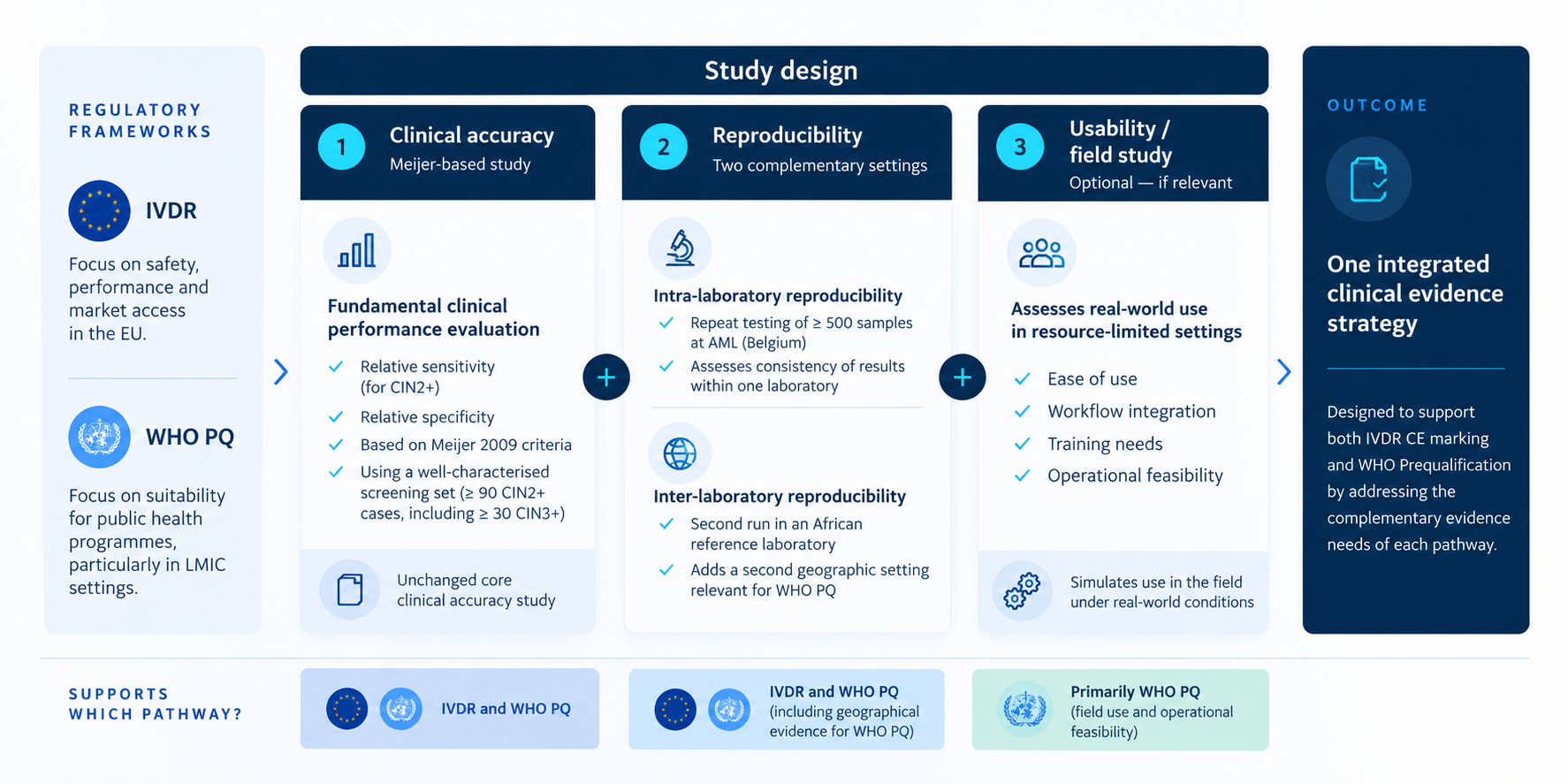
QbD Group’s network of qualified sites in more than 25 countries across Europe and Africa made it possible to match each component to the right site.
Result
One clinical evidence strategy, two regulatory pathways.
The strategy was designed from the outset to support both IVDR CE marking and WHO Prequalification, identifying opportunities to leverage shared evidence while addressing pathway-specific requirements through targeted additional activities. This integrated approach aims to avoid unnecessary duplication of clinical study activities while generating the evidence required for each pathway. Clinical and regulatory outcomes will be reported once available.
- A Meijer-based clinical accuracy study serving both pathways
- Reproducibility testing in Europe and Africa, adding the geographical evidence needed for WHO
- A field usability study addressing workflow, training needs and operational feasibility
- Both pathways mapped upfront, with the intended purpose guiding populations, settings and claims
- A recognised reference-laboratory network supporting the scientific credibility of the approach