
Three Sponsorship Models for Combined IVD-Drug Studies: How to Choose the Right One for Your Program
Combined studies, where an Investigational Medicinal Product (IMP) clinical trial runs alongside an IVD performance study, often for a companion diagnostic (CDx), are among the most complex programs in clinical development.
They involve:
- parallel regulatory tracks,
- shared patients and specimens,
- and multiple stakeholders with different strategic interests.
At the heart of this complexity sits a deceptively simple question: who sponsors which component?
The clinical trial and the IVD performance study may share:
- patients,
- specimens,
- timelines,
- and even study sites.
But they follow separate regulatory frameworks, and each requires an identifiable Sponsor ultimately responsible for regulatory compliance within its respective framework.
Getting this governance structure right from the start is essential — not just for compliance, but for the long-term defensibility and usability of your clinical evidence.
In practice, three primary sponsorship models exist for combined studies. Each has distinct advantages, risks, and conditions under which it works best.
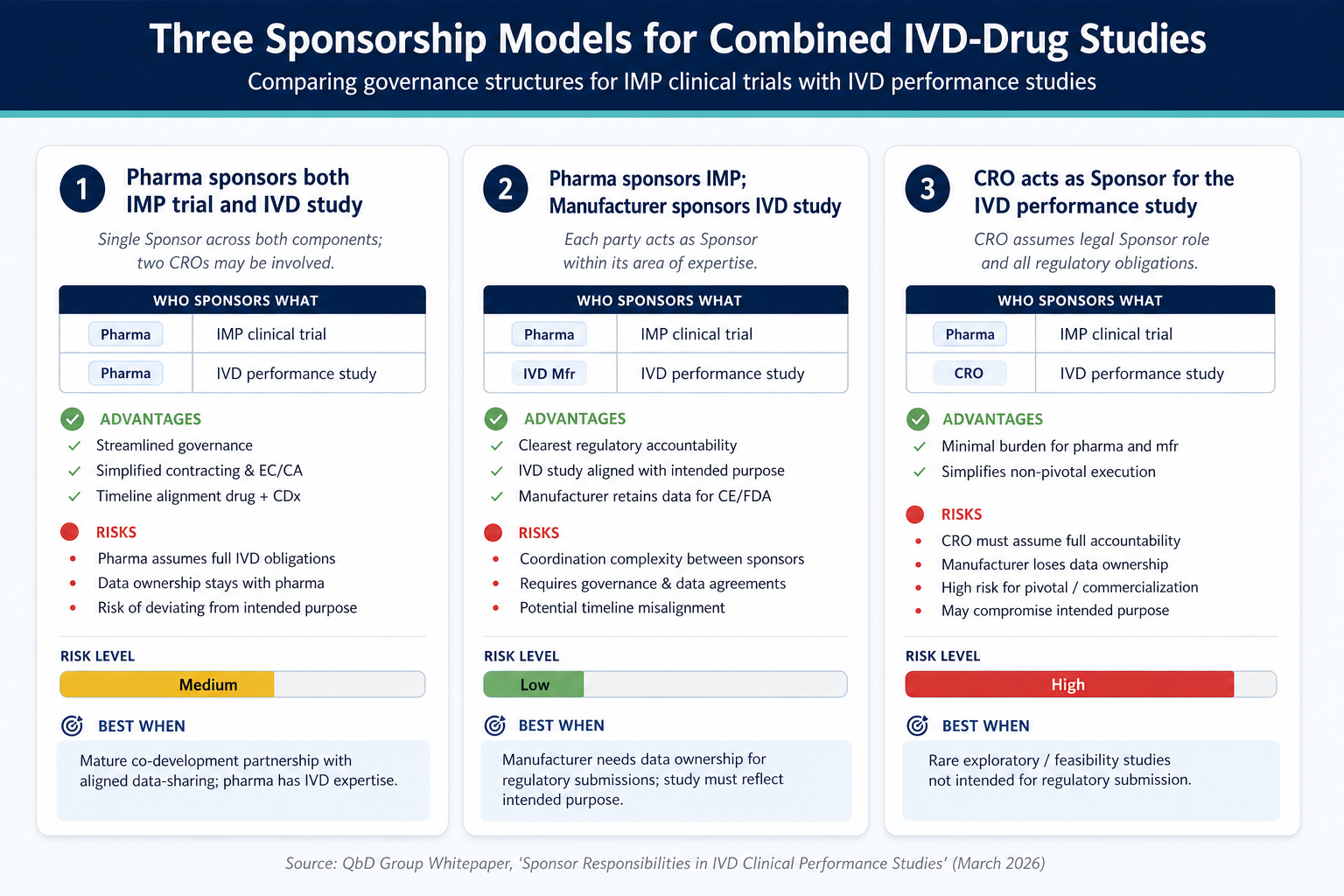
Model 1: The Pharmaceutical Partner Sponsors Both the Clinical Trial and the IVD Performance Study
In this model, the pharmaceutical company acts as a single Sponsor across both components. Two separate CROs may still be involved:
- one for drug-related clinical trial activities,
- and another for IVD-specific operational tasks.
This model offers streamlined governance. A single Sponsor simplifies:
- contracting,
- communication with ethics committees and competent authorities,
- and coordination across study sites.
It also allows the pharmaceutical partner to align drug development timelines directly with CDx availability. However, the risks are significant.
The pharmaceutical partner assumes full legal responsibility for IVD-specific obligations, including:
- General Safety and Performance Requirements (GSPR) compliance,
- analytical and clinical performance justification,
- and device-related safety oversight.
This requires IVD expertise that many pharma organizations do not have in-house. There is also a data ownership consideration: the pharmaceutical partner controls or holds primary access rights to the IVD performance data, even though the diagnostic manufacturer typically needs these data for their own regulatory submissions.
Perhaps most critically, pharma-led study design decisions may unintentionally deviate from the diagnostic manufacturer's intended purpose.
For example:
- testing new indications,
- using different sample types,
- or expanding patient populations
can redefine device claims, increase regulatory risk, and potentially trigger legal manufacturer obligations for the pharmaceutical partner.
This Model Works Best When:
- The pharmaceutical partner and diagnostic manufacturer have a mature co-development partnership
- Data-sharing and confidentiality agreements are already well aligned
- The pharmaceutical partner has sufficient in-house IVD expertise or specialized external support
- The diagnostic manufacturer is comfortable sharing technical documentation and oversight responsibilities
Model 2: The Pharmaceutical Partner Sponsors the Clinical Trial; the Diagnostic Manufacturer Sponsors the IVD Performance Study
Here, each party acts as Sponsor within its own area of expertise. The pharmaceutical company sponsors the drug trial, while the IVD manufacturer sponsors the performance study.
The studies may still run in parallel within a coordinated co-development program, often with separate CROs engaged for:
- drug-related activities,
- and IVD-specific operations.
This model provides the clearest regulatory accountability. Each party manages its own obligations, and the IVD study design remains aligned with:
- the device's intended purpose,
- the risk management file,
- and the technical documentation.
The diagnostic manufacturer also retains ownership and control of performance study data, which is critical for:
- CE marking,
- conformity assessment,
- and United States Food and Drug Administration (FDA) submissions.
The trade-off is coordination complexity. Running parallel studies requires:
- robust governance,
- clear communication structures,
- and formal data-sharing agreements.
Without these, timeline misalignment between drug development milestones and IVD study completion becomes a real risk.
This Model Works Best When:
- The diagnostic manufacturer needs to retain control of performance study data
- The study design must remain tightly aligned with the device's intended purpose
- The pharmaceutical study relies on biomarker-defined patient selection
- Both parties are capable of implementing formal governance and data-sharing frameworks
Model 3: A CRO Acts as Sponsor for the IVD Performance Study
In this model, the CRO assumes the legal Sponsor role for the IVD performance study. This means the CRO takes on full responsibility for:
- GSPR compliance,
- intended purpose justification,
- safety reporting,
- and long-term data retention.
Operationally, this may appear attractive because it reduces the immediate burden for both the pharmaceutical partner and the diagnostic manufacturer. It can also simplify execution for exploratory or feasibility studies not intended for regulatory submission.
However, the limitations are substantial.
The CRO must assume full Sponsor accountability for:
- device-specific regulatory compliance,
- monitoring,
- reporting,
- and oversight.
For complex IVDs or companion diagnostics, this is often unrealistic.
At the same time, the diagnostic manufacturer loses a significant degree of control over:
- study conduct,
- data access,
- and long-term regulatory usability of the evidence.
For pivotal clinical trials or devices intended for commercialization, CRO-led sponsorship may compromise:
- regulatory compliance,
- intended purpose alignment,
- and data ownership strategy.
This Model Is Generally Reserved For:
- Early exploratory or feasibility studies
- Programs not intended for regulatory submission
- Situations where neither the manufacturer nor the pharmaceutical partner can temporarily assume Sponsor obligations
- Contexts where operational simplicity outweighs long-term regulatory ownership considerations
Making the Decision
Choosing a sponsorship model for a combined study is not merely an administrative exercise. It shapes:
- who controls the study,
- who owns the data,
- and how the evidence will ultimately support regulatory submissions for both the drug and the diagnostic.
The right model depends on:
- your regulatory strategy,
- the maturity of the pharma-IVD partnership,
- internal expertise,
- and long-term evidence requirements.
Getting independent guidance before study startup can prevent costly misalignment later in development.
Want the Full Comparison Framework?
This blog is part of a broader series exploring Sponsor responsibilities in IVD clinical performance studies.
Download our white paper Sponsor Responsibilities in IVD Clinical Performance Studies for a detailed comparison of all three sponsorship models, including:
- advantages and limitations,
- governance considerations,
- data ownership implications,
- and practical decision criteria.
Sponsor Responsibilities in IVD Clinical Performance Studies →
Looking for Guidance on Combined Study Governance?
At QbD Group, we support pharmaceutical companies, biotech firms, and IVD manufacturers in structuring combined study governance models aligned with IVDR and FDA expectations.
Want to discuss which sponsorship model best fits your program? Talk to our experts and build the right governance structure from the start.