
Your CDx Performance Study: Why the IVD Sponsor Matters More Than You Think
Performance studies are the backbone of clinical evidence for in vitro diagnostic (IVD) and companion diagnostic (CDx) devices.
Yet in our experience working with pharma companies, biotech firms, and IVD manufacturers across Europe and beyond, one question consistently creates confusion at the very start of a program:
Who takes on the role of Sponsor of the IVD Performance Study, and what does that responsibility actually entail in practice?
It is a question worth answering early.
The decision shapes study design, determines data ownership, defines regulatory accountability, and ultimately influences whether your clinical evidence will withstand scrutiny at the point of CE marking, FDA submission, or Notified Body review.
A Single, Identifiable Entity
Across the major regulatory frameworks:
- the European Union (EU) In Vitro Diagnostic Regulation (IVDR) (Regulation (EU) 2017/746),
- the FDA Investigational Device Exemption (IDE) framework under 21 CFR Part 812,
- and the international ISO 20916 standard for Good Study Practice,
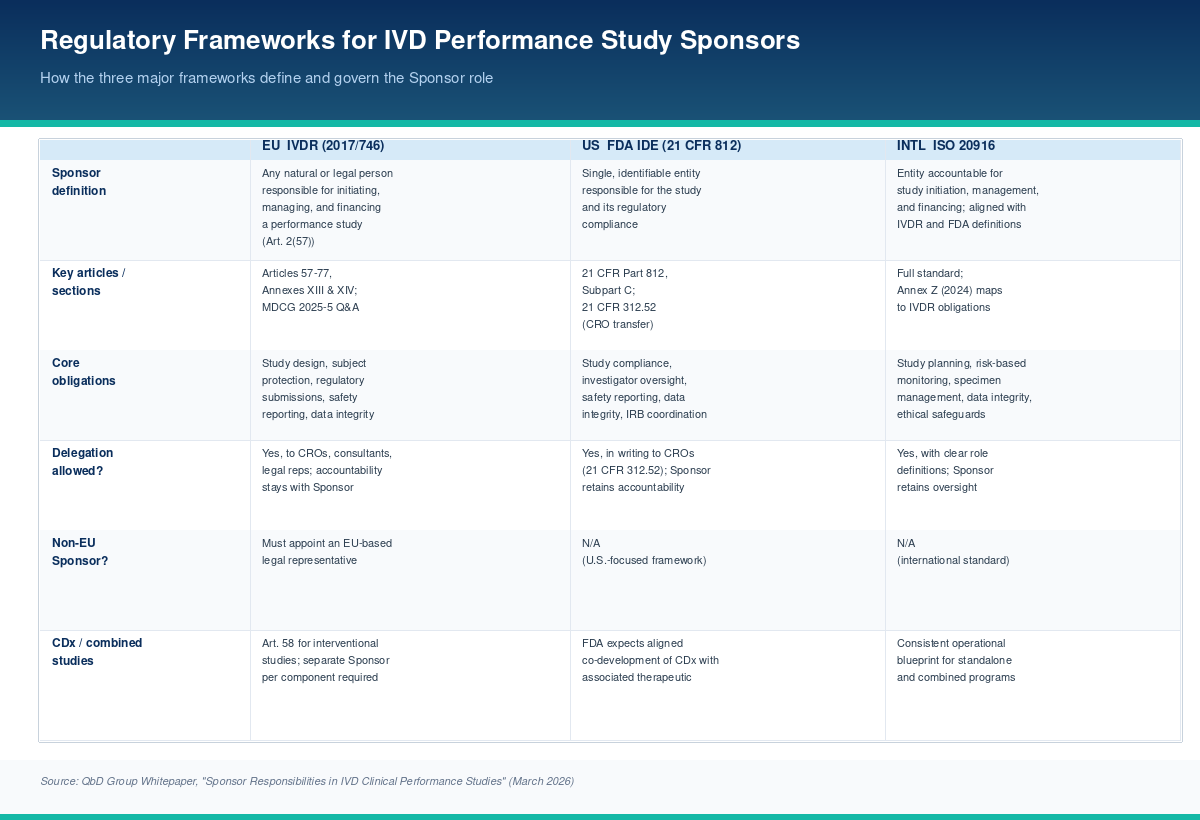
the Sponsor is consistently defined as a single, identifiable entity that carries ultimate responsibility for initiating, managing, and financing the performance study.
Under the IVDR specifically, Article 2(57) defines the Sponsor as any natural or legal person who takes responsibility for initiating, managing, and setting up the financing of a performance study.
Where that entity is not established within the EU, a legal representative must be appointed to ensure compliance with applicable regulatory obligations.
The Medical Device Coordination Group (MDCG) 2025-5 Q&A further clarifies Sponsor definitions, responsibilities, and procedures, including expectations for combined studies.
In the United States, the structure is comparable. Sponsors operating under the IDE framework remain responsible for study conduct and regulatory compliance. While operational activities may be delegated in writing to Contract Research Organizations (CROs) under 21 CFR 812.40–812.46, ultimate accountability remains with the Sponsor.
What Does the Sponsor Actually Have to Do?
Regardless of jurisdiction, Sponsors are expected to ensure:
- the scientific integrity of the study,
- the ethical conduct of the study,
- subject protection,
- and adequate oversight of delegated activities.
In practice, Sponsor responsibilities typically include:
- Selecting and qualifying investigators and study sites
- Managing regulatory submissions and ethics committee/institutional review board approvals
- Maintaining control of the investigational IVD
- Managing adverse event evaluation and safety reporting
- Ensuring data integrity, completeness, and proper documentation
- Establishing procedures for risk management and corrective actions
These responsibilities are not simply administrative checkboxes. They form the regulatory foundation on which the credibility, acceptability, and long-term usability of performance study data depend.
Why This Matters for Precision Medicine and CDx Programs
Within precision medicine and companion diagnostic (CDx) co-development, sponsorship decisions become even more strategic. The organization assuming the Sponsor role directly influences:
- study design authority,
- ownership and control of the resulting evidence,
- regulatory accountability,
- and the ability to generate clinical evidence supporting both device approval and market access for the associated therapeutic product.
When a pharmaceutical company is developing a targeted therapy alongside a companion diagnostic, the question of IVD study sponsorship is not merely administrative: it''s strategic. Misalignment at this stage can:
- delay development timelines,
- create disputes around data ownership,
- or generate evidence that fails to meet regulatory expectations for either the drug or the diagnostic.
ISO 20916: The Operational Bridge
ISO 20916 remains an important, though sometimes underutilized, framework for global IVD performance studies.
While not legally mandated in the U.S., this international standard for Good Study Practice provides a practical blueprint that aligns closely with both IVDR requirements (Articles 57–77, Annexes XIII and XIV) and FDA expectations.
The 2024 version of ISO 20916 introduced Annex Z, formally mapping ISO 20916 clauses against IVDR obligations. This gives Sponsors a practical methodology for aligning operational study execution with EU regulatory requirements while maintaining high scientific and ethical standards.
For organizations managing international IVD performance programs, ISO 20916 can support consistency across:
- study planning,
- risk-based monitoring,
- specimen management,
- data integrity,
- and oversight of delegated activities.
The Bottom Line
Understanding the Sponsor role is not merely a regulatory formality.
It is the foundation for every strategic and operational decision that follows within an IVD performance study, from partnership structures to the long-term defensibility of the generated evidence.
In upcoming posts, we will further explore:
- the distinction between delegating operational activities and transferring legal Sponsor responsibilities,
- sponsorship models for combined IVD-drug studies,
- and key considerations when selecting a CRO partner.
Want the Full Picture?
Download our white paper Sponsor Responsibilities in IVD Clinical Performance Studies for a comprehensive overview of:
- regulatory frameworks,
- sponsorship models,
- Sponsor obligations,
- and practical decision-making guidance for global IVD performance programs.
Sponsor Responsibilities in IVD Clinical Performance Studies →
Looking for Support with Your IVD Performance Study Strategy?
At QbD Group, we support pharma companies, biotech organizations, and IVD manufacturers in defining sponsorship models, structuring global performance studies, and navigating IVDR and FDA expectations with confidence.
Want to discuss how to structure your IVD performance study from both a regulatory and operational perspective? Contact our experts to explore the right setup for your program.