
Delegation vs. Transfer of Sponsor Responsibilities: The Line Every IVD Performance Study Sponsor Needs to Draw
One of the most consequential decisions in any IVD performance study happens well before the first sample is collected.
It is the decision about what to keep in-house and what to outsource, and more importantly, understanding the regulatory difference between delegating tasks and transferring Sponsor responsibilities.
In practice, these two concepts are often confused. And the consequences of getting it wrong range from compliance gaps to loss of data ownership.
Delegation: Outsourcing Tasks, Retaining Accountability
Most Sponsors engage external partners at some point during a performance study.
This is standard practice and, when done well, it accelerates timelines, reduces resource burden, and brings in specialized expertise.
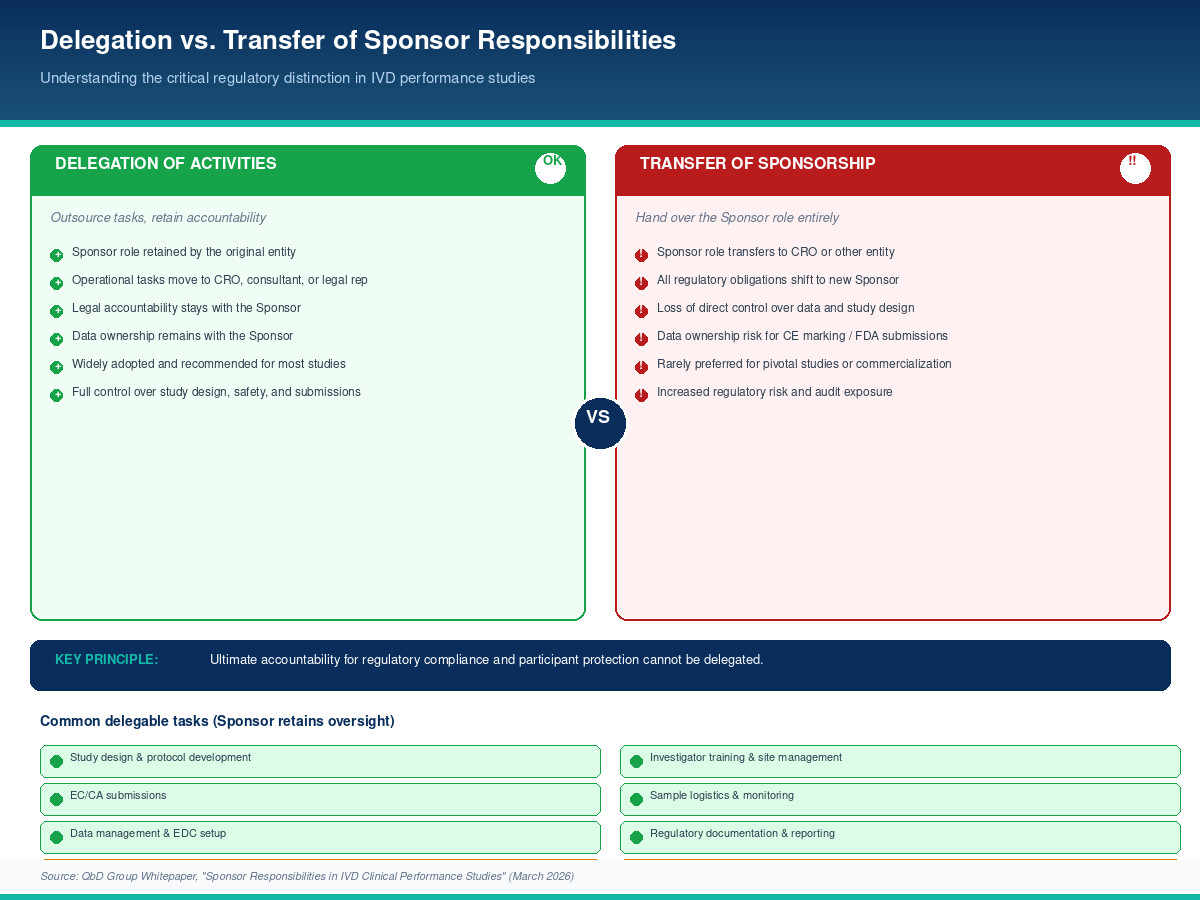
Under both the EU IVDR and the U.S. FDA IDE framework, Sponsors can delegate a wide range of operational tasks to Contract Research Organizations (CROs), regulatory consultants, or legal representatives without giving up their role as Sponsor.
Commonly delegated activities typically include:
- Study design support, protocol development, and feasibility assessments
- Investigator training and site management
- Operational execution such as ethics committee submissions and sample logistics
- Data management, including electronic data capture setup and query resolution
- Reporting activities and regulatory documentation writing
- Project management
The key principle here is straightforward: while the tasks move to an external partner, the legal and ethical accountability stays with the Sponsor. The CRO, consultant, or legal representative acts under the Sponsor's oversight.
Transfer: Handing Over the Sponsor Role Entirely
Transfer is a fundamentally different arrangement. When a CRO or another entity takes on the formal Sponsor role, it assumes all regulatory obligations, including:
- device safety compliance,
- study conduct oversight,
- safety reporting,
- adverse event follow-up,
- regulatory communication,
- and long-term data retention.
Under the IVDR, the entity acting as Sponsor must meet the full definition under Article 2(57), meaning it is responsible for:
- initiating the study,
- managing the study,
- and financing the study.
Under FDA regulations, transfer of obligations to a CRO must be documented in writing under 21 CFR Part 812.40, and delegated tasks remain subject to FDA enforcement even after transfer.
This distinction matters.
For device manufacturers, transferring the Sponsor role to a CRO can complicate control over the performance data supporting:
- CE marking,
- FDA submissions,
- and broader regulatory strategy.
For pharmaceutical partners in combined studies, assuming Sponsor responsibilities for the IVD component introduces obligations they may not be equipped to manage, including:
- General Safety and Performance Requirements (GSPR) compliance,
- analytical and clinical performance justification,
- and device-related safety oversight.
Why Full Transfer Is Rarely Preferred
In our experience, full transfer of Sponsor responsibilities is uncommon for performance studies, and for good reason.
When a manufacturer gives up the Sponsor role, it may complicate:
- control over study design alignment with intended purpose,
- data ownership needed for conformity assessment and regulatory submissions,
- safety reporting and adverse event management,
- and long-term evidence defensibility.
For pharmaceutical companies, taking on IVD Sponsor responsibilities in a combined study means accepting legal obligations around device-specific regulatory compliance, an area where many pharma organizations lack deep expertise.
It also increases inspection and audit exposure under both IVDR and FDA frameworks.
The Practical Takeaway
The question is not whether to engage external partners.
The question is how to structure that engagement so that you retain the oversight and accountability regulators expect, while still benefiting from the efficiency and expertise that experienced partners provide.
In practice, this means:
- Establishing clear contractual frameworks defining delegated tasks and reporting lines
- Maintaining oversight mechanisms such as monitoring, auditing, and regular reviews
- Ensuring the Sponsor retains authority over study design, safety decisions, and regulatory submissions
- Selecting partners who understand IVD-specific requirements, not only pharma clinical trial operations
Regardless of how many activities are delegated, one principle remains consistent across all regulatory frameworks: ultimate accountability for regulatory compliance and participant protection cannot be delegated. Every operational partner acts only under the Sponsor's oversight.
Want the Full Framework?
This blog is part of a broader series exploring Sponsor responsibilities in IVD clinical performance studies.
Download our white paper Sponsor Responsibilities in IVD Clinical Performance Studies for a more comprehensive overview of:
- sponsorship models,
- delegation structures,
- CRO selection considerations,
- and governance approaches for combined studies.
Sponsor Responsibilities in IVD Clinical Performance Studies →
Looking for Support Structuring Sponsor Oversight?
At QbD Group, we support pharma companies, biotech firms, and IVD manufacturers in defining Sponsor models, governance frameworks, and operational oversight structures aligned with IVDR and FDA expectations.
Want to discuss how to structure Sponsor responsibilities and delegation models for your performance study? Talk to our experts and build the right framework from the start.